


Artificial Intelligence

Directions / Laboratories

of 15 partners
8 Companies

About HRIA
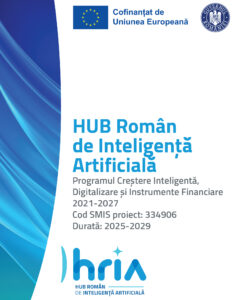
The project ”Romanian Hub for Artificial Intelligence – HRIA” is developed under the framework of the Smart Growth, Digitalization and Financial Instruments Programme 2021–2027 (PoCIDIF), co-financed by the European Regional Development Fund (ERDF), Priority Axis 4 – Development of Strategic Technologies for Europe – STEP, Call PCIDIF/709/PCIDIF_P4/OP1/RSO1.6/PCIDIF_A12 – Action 4.1 – Support for the Development of Strategic Technologies for Europe – STEP, SMIS Code 2021–351416. The HRIA project is implemented by the National University of Science and Technology POLITEHNICA Bucharest, as the main beneficiary, in partnership with six nationally representative universities: Technical University of Cluj-Napoca, West University of Timișoara, “Gheorghe Asachi” Technical University of Iași,
Politehnica University of Timișoara, University of Bucharest, Babeș-Bolyai University of Cluj-Napoca. Additionally, eight innovative SMEs were selected through a competitive and transparent process to contribute to the project. HRIA aims to develop a national ecosystem of excellence in Artificial Intelligence, distinguished by its unique scope in Romania in terms of research, development, and innovation activities, as well as its tangible economic impact. The project serves as a catalyst for consolidating the efforts of Romania’s AI community, enhancing its visibility and influence at European and global levels. It fosters the creation of national resources for AI development and innovation, supporting all sectors of society.
Research Directions / Laboratories

Trustworthy AI
Development of reliable methods and models in machine learning (ML), computer vision, robotics, natural language processing, and explainable AI.

Intelligent and Autonomous Systems
Autonomous and connected mobility, assistive and social intelligent robots, autonomous navigation, and intelligent control systems.

Intelligent Human–Computer Interfaces
Interaction systems capable of understanding written and spoken natural language, intelligent multimodal interfaces, and AI technologies operating at the intersection of the physical and virtual worlds.

AI Hardware Technologies
Energy-efficient AI models and smart sensor networks.
AI in Medicine and Healthcare
Medical imaging, diagnostics, preventive and personalized medicine, and technologies for active and assisted living.

AI in Cybersecurity and Space
Intelligent applications for cybersecurity and space surveillance.

AI for Smart Cities
Intelligent energy efficiency, integrated solutions for smart urban environments, and technologies promoting healthy living.

AI for the Environment
Smart solutions for climate change monitoring, emergency detection and prevention, and satellite and drone image analysis.

Development and Testing of AI Prototypes and Systems
Creation of functional pilot projects, application across diverse use cases, and testing and validation of AI systems and services.